|
Laboratory
investigation revealed that
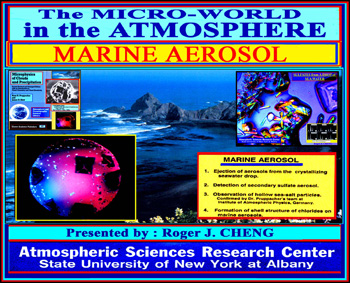
a shell structure of
chlorides (MgCl/2 and KC1) is always
present on the surface of marine aerosol. Close examination by
a polarizing microscope of an individual seawater droplet has
resulted in the following observations: Evaporation of water increased
the salt concentration. At first, a thin layer of
brine formed at the surface of
the evaporating droplet; this was followed by clearly sequential
precipitations of numerous
microcrystals of sulfates
(CaSO/4 MgSO/4), and by a crust of
many relatively larger cubic NaCl crystals correspondent
with their individual
solubility and concentrations. During this process solution
of chlorides (MgCl/2,
KCl) mixed with microcrystals of sulfates or NaCl were
situated beneath the surface of the droplet finally, a sea salt
particle with chloride film on the surface was formed.
The
shell structure of chlorides
film present on the surface of the marine aerosol confirmed via
optical and scanning electron microscopy is of
extreme importance
to understanding the fundamental nucleation processes in the atmosphere.
A chloride film presents a highly hygroscopic surface and was
found to initiate the condensation of water in
environment with RH as 40%. Sodium chloride (NaCl) crystals,
on the other hand play
only a minor role in initiating condensation (RH 75%) for cloud
droplets formation in the atmosphere.
|
Presented
at the Annual Meeting
of the American
Association for Aerosol
Research (AAAR),
Brook,
Illinois, October
11-15, 1993
|
 |
|
|





.jpg)
